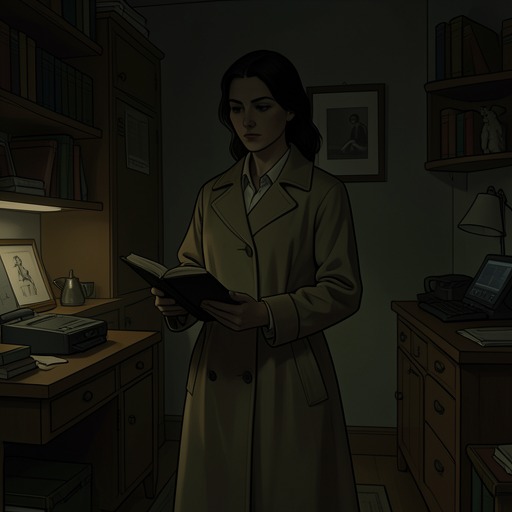
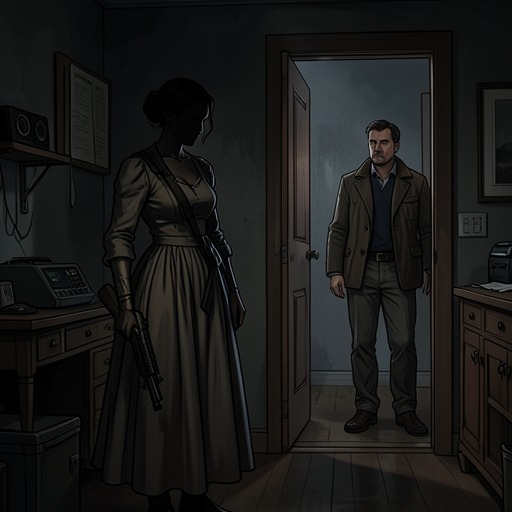
Leonberger family raid
News of the WorldThe Leonberger family raid is presented through its aftermath: a family’s account of murder, a failed pursuit, and the lasting separation of Cicada from her kin. The attack is not shown directly. Instead, Wilhelm and Anna Leonberger recount what happened, while later scenes reveal the distance between Cicada’s German relatives and the life she had come to know among the Kiowa.
The family’s account
Wilhelm tells Jefferson Kyle Kidd that his brother and sister-in-law—Cicada’s parents—were found murdered. He describes the violence done to their bodies; Anna adds that Cicada’s mother was assaulted before she was killed. Their testimony makes the attack more than an unexplained loss: it is a family trauma that the survivors can only recount in fragments, with Wilhelm’s account breaking into short, blunt statements.
Anna also describes the murder of Cicada’s little sister, whose body was left hanging by one leg from a tree on the Sabinal, near a store. The details make the family’s bereavement concrete, but the narrative does not identify a specific people as the attackers in this account. Its language records the Leonbergers’ horror rather than establishing who carried out the raid.
The failed pursuit
The family tried to catch the killers. Anna says the men rode their horses until the animals were exhausted, but no pursuit succeeded. That failure left the murders without redress and did nothing to restore the surviving family’s sense of safety. The account makes the chase a second injury: the effort was immense, but it ended without the perpetrators being caught.
Jefferson Kyle Kidd listens as Wilhelm and Anna speak. He answers with restrained sympathy, and the account unsettles him physically. His response cannot undo the loss; it marks the distance between hearing of violence and being able to repair what it has done. For Cicada, the consequences are not confined to the deaths themselves: she is separated from her surviving relatives and grows up within another community.
Separation and belonging
A later scene at the flooded Red River along the Texas–Indian Territory border gives that separation an image. Cicada stands on one bank while a Kiowa party waits on the other. She calls to them in Kiowa, but the rising water and its noise prevent them from hearing her. The narration presents her call as reaching toward her parents, siblings, and the life of travel on the Plains that she associates with her people. The scene does not identify the party as the raiders; instead, it shows the pull of the community in which she has lived and the impossibility, at that moment, of crossing back to it.
The raid therefore stands behind a divided inheritance: Cicada’s German family remembers her as a child taken from them, while her attachment to Kiowa life remains powerful. The later account of her being taken from the Kiowa by an Indian Agent preserves that loss in another form, as a story told and retold alongside the lives of Kiowa warriors. The attack is not resolved by her return to relatives; its consequences persist in the competing claims of family, memory, and belonging.